I awake one morning
to the sound of clunking pattering above me as if the tumbling sky
unleashed fury in
dropping everything it could find — the waste of molten
earth melding green on brown in
my mind my eyes now blind and my breath as that of a worm which, I wondered,
have I come to inhabit
this body of the underground?
and I,
was my duty
to swallow it all without a cry or anguish
so I reached out:
only my hands felt the earth, but my whole body
and whole world
was nothing but the experience of being my hands
buried in moist soil.
I felt their hands reach into the earth touch my body
(of hands)
and there were colors everywhere, though I was blind.
I felt endless miles of branches of roots
of the span of the earth stretching out far
beneath me,
all around me
(bubbling up between buildings and asphalt
remembrance of its own continuity). (1)
my hands gripped the posts driven into the earth like a rope underwater
as I felt the earth tremble, shiver,
a quiet, incessant hum falling from the freeway, (2)
like a lightning split (3) of the ghosts of immigrant homes
except the thunder never ceased. (4)
The sun still hangs halfway up the sky
the gardeners stooped in their plots
share a water hose, and
I watch
as the words
fall from their mouths
fall upon the earth
in accents,
twisted tongues,
dying dialects,
and some of them understand
some do not, but
smile (teeth
yellowed from
age, missing
some,
crooked with a lifetime of smiles and
frowns) nonetheless (5) –
and I hold out my hand to catch their languages
knowing I might choke
on every
word like
tears cried
for those years of
speaking on a different
land nowhere to go
and those years
together finally
on this land, growing.
I reach, reached out, to touch the waste –
wondering, what waste? (6)
Here are the old mangled leaves of kabocha squash, vines of chinese long bean and
yam their body / substance / returning to the depths
turning slow circles as matter of life wondering to
themselves when the hairiness of being so many different
forms at once
at once gaseous, solid, liquid dissolved,
odorous, visibly falling apart, and invisible
buried under
congeals to stable state and settles far down in the ground, in the valleys of
time (7) here are the old cardboard boxes
that contained some other container (yeah, probably plastic)
(the magic of carrying something swaddled in multiple layers of
intensively MANUFACTURED material) (8)
soaked sopping pulpifying over
soon I will see its pile of cellulose heading my way again, once in some far away land (land of nature, purer than anything here amidst the concrete jungle) in the depths of a forest, where its hydrocarbons were pulled slowly from the ground, assembled from the place I now blindly inhabit, float in, embody, encapsulate; combined with: the air I drink from above, its gift of water, and the ancient sunshine
here are the multi-colored plastic
containers single-use: use once
loathed as (in) humanity’s consumer excrement
and still nobly serving their purpose, holding our
shit and it’s harder for me to see,
here,
where they came from,
from what depth of buried earth these fossil kin were
ripped (9) an eternal sleep broken to stoke the flames of:
the [INDUSTRY] [machine] – every car on the freeway every plane in the air even the
*bulldozer* used to sculpt the hillside that would eventually become the garden (10)
and with the byproduct of these ancient earth
dwellers a single-use afterthought
is brought into the
world I am listening for their
murmur
the way their bodies sound now, in this hardened, mute
form the way they sound when they brush up soft
on each other
on the water pouring out from their obligate
cavities on the gardeners’s hands
on me
I see in layers
soil studded and stratified, these little gems of culture,
the drying rack-turned trellis
the fence made of the plastic frame that holds window blinds to the
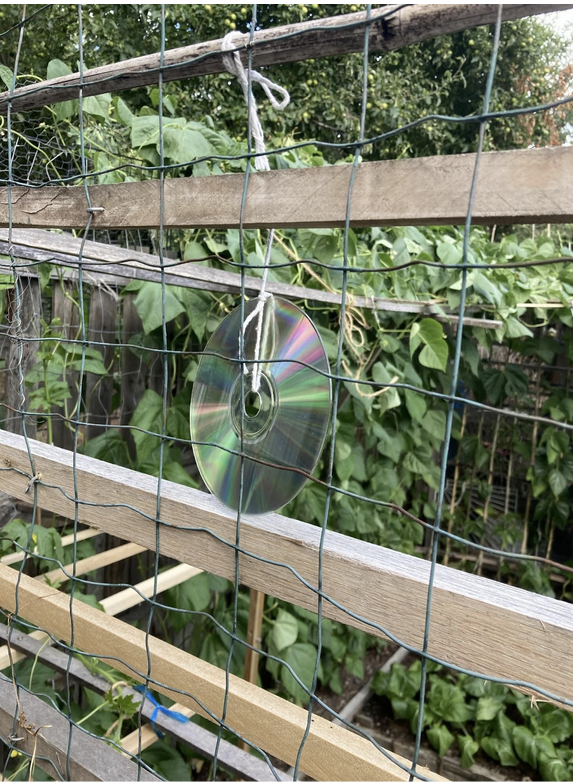
window the old CD hanging from a string as a bird deterrent (11)
every bit of a society built on the act of throwing it
away, putting it out of mind, the excess and waste
heaping on piles of sprawling on detritus, teetering inward on the precipice of
collapse obscured by the delusion of
open earth elsewhere, dumping grounds
barren, unnatural sites to bear unnatural waste
like the lands that these gardeners call home
(and I will hold it all)
I divide and multiply, hands enough to hold together
every garden structure leaning upon each other,
knowing
these elderly gardeners are more than messy hoarders of useless
plastic this is all they know
taught from childhood to make do with
anything to save, stretch resources as far as
possible
and though the messiness is theirs, I claim it as mine too.
I climb up through the fruit trees shading the gardeners (12)
watch as they plant, pull, move slowly around their small
plots;
relentless in their care, I exhale with the wind blowing in from the Sound
and feel in my roots the press of feet, the feet of millenia, firm on ground now nurtured with
fallen fruit,
fresh in its cycle through earth / life / and old as the bones holding the garden together in
multi-color disarray.
Footnotes
1. I was sitting in Grieg Garden on the UW campus one day, looking at how much space there was (for a built environment) for leaf litter to fall and roots to grow. I think about that a lot: hard surfaces that are expected to be clean vs. “soft” surfaces, like forest floor, that accept debris of all kinds and doesn’t get a second look about what’s in/on it, decay, mess, and all. I thought about how close the soft surface of Grieg Garden was to the hard surfaces of roads, paths, and buildings through campus, and all of a sudden, I could see Earth below stretch out underneath everything. Despite compacted soil, foundations poured tens of feet underground, tunnels, and all the other infrastructure of urbanism, under every surface lay more continuous Earth.
2. The Danny Woo Community Garden is a peaceful place, but it is surrounded by an endless wall of noise. It is located right by I-5, which offers a homogenized stream of tires on asphalt. Occasionally, the noise from the freeway is highlighted by a semi truck’s compression brakes, a motorcyclist gunning the gas, or the unmuffled exhaust of someone tearing through downtown far too fast. Then, there are planes that fly overhead every 1-2 minutes, loud enough to drown out the sound of any reasonable thought in one’s head.
3. I imagine the lightning as the flash of destruction, development – the seemingly unstoppable force that wipes out a whole community in one strike.
4. In the 1960s, the construction of the Interstate 5 freeway razed a whole neighborhood in Chinatown, displacing hundreds of people who used to live on the hillside. The freeway split the district in half and is now a major source of noise and air pollution. The construction of the freeway through a minority community was not unique to Seattle’s Chinatown; it was another instance of environmental racism, in which much of the burden of a large civic project fell on Seattle’s marginalized Asian groups. With the regular sweeps of the unhoused people who live under or around it, the freeway continues to be a symbol of displacement. And so its divisive legacy lives on as a strip of virtually uninhabitable land (Ray).
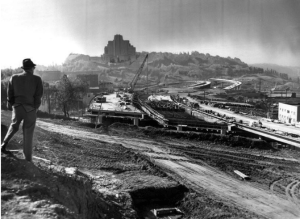
Construction of the I-5 freeway through Chinatown, stretching southward in the picture. Image from International Examiner, courtesy of Wing Luke Museum (Ray)
5. This intimate image of the gardeners speaking to each other, sometimes in the same language and dialect, sometimes not, defines the garden as a hybrid, natural space, a space in which all forms of life, all forms of material, flourish. Natural spaces are not meant to be isolating; they are for humans just as much as they are for plants and animals. Natural spaces are not meant to have some sort of “service” attached to them; even if they do fulfill an “ecosystem service,” they are first and foremost natural spaces. Somehow, a natural space in the city is subject to far more obligations, i.e. contributing to local sustainability, potential for urban biodiversity, improving cities’ adaptation to climate change. These examples were all taken from article titles in the picture below, and the words in bold show how easily an urban natural space can fall into a homogenous whole of green squares scattered across a city’s map, checking off as many boxes as possible under “ecosystem services.” During my research, one results page from a search for “community gardens” AND “natural” made me feel especially frustrated:
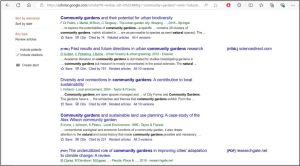
Now, I realize I digressed from community gardens to natural spaces fairly quickly, but! Here’s the thing: if a garden, which has a far more utilitarian connotation than a natural space, can only be seen for how it furthers one human agenda or another, whether it be biodiversity or sustainability or food sovereignty, it still loses its inherent value as a garden and a natural space. Perhaps my problem is not so much with the language of different ecosystem services (except that very phrase – “ecosystem services.” I just don’t know how else to generalize them), but singling them out within a garden or natural space. See note 6 for a less flustered, more positive (as in, not so many not’s/what a garden should not be and instead what it is) elaboration on my thoughts here.
6. I’m considering this word in two forms: waste, as in rubbish; and waste, as in a missed opportunity, as if the garden’s land could be used for so much more. Here is where the stakes of my poem become clearer, because so much of it grapples with a murky, abstract notion of what is considered “natural.” If our cultural views of what is considered “natural” dictate what kind of land deserves designation as open, natural space and only open, natural space, then something like a community garden – especially one that appears as messy as the Danny Woo Garden – is doomed. In The Informal American City, Jeffrey Hou writes, “community gardens remain one of the most poorly defined types of land use… Institutionally, gardens are often considered as an interim use, eventually to be replaced by a higher-end development” (79). Hou shows the unstable, temporary positions that community gardens often occupy – not important enough to save in the face of a high-end development, but important enough to expend the time and energy to create a garden for a short amount of time before being built over.
The fact that community gardens fulfill such a range of roles within an urban space is the very reason why they defy easy definition. Not only are they spaces for food production, but for urban renewal, community gathering space, natural area, habitat for all kinds of life, etc (81). In my poem, I also consider what it means for the life and land of a garden to deserve preservation in their own right, as miracles of life flourishing in the city beyond their services to humans. However, this intrinsic value is complicated by the way land is cared for and how it looks aesthetically, as it is in the Danny Woo Garden. Hou and Chalana echo this sentiment in Chapter one of Messy Urbanism, in which he points out that there is a “danger of aestheticizing poverty and the ‘seductive lure of Third World informality’ that further exacerbates the inequalities that already exist in such cities by a misplaced focus on aesthetic improvement of the built environments of the poor” (9). It is not the aesthetic of messiness that we need to praise or be repulsed by, but what we can genuinely learn from it: “The focus on informality and messiness here highlights the roles and contributions of diverse actors in the making of the urban environment, economy, and city life” (9). Understanding urban messiness as one of the core aspects of a city – and especially an Asian city – rather than as something to be cleaned up, can inform what kinds of space deserve attention and preservation as inalienable, or rather, inevitable, public and community space.
7. How long will it take for all of this to decompose? More than that, how long will it take to settle, for this matter and these bodies to rest once more? I’m thinking about this all with the fossil kin in mind (see note 9), as well as long-term carbon storage, as well as a routine of care – in the form of gardening, putting hands into earth day after day. How long will it take for this matter to be undisturbed, not something to be extracted from the soil?
8. To think that the pulp of paper (churned from the bodies of felled logs that grew for forty or more years), and the resin of plastic (made from animal bodies fossilized for thousands and millions of years) is the result of our beautiful precision craft processes of manufacturing for the sole pleasure-habit of breaking it down for the trash can.
9. In her article “Fish, Kin, and Hope,” Zoe Todd reimagines petrochemical products like oil, gas, and plastic as fossil kin rather than as weaponized “petro-capitalist extractions” (107). She does this through her perspective of a Metis woman whose family has long been deeply tied to the North Saskatchewan River, and who must reflect on her “responsibilities to ‘inert’ or polluting materials, like the oil that spilled into the North Saskatchewan River” (106). I wanted to reimagine plastic in the Danny Woo Garden in the same way. By viewing plastic as fossil kin, we must reconsider the origin, function, journey, and endpoint of the reused plastic materials in the garden – as agential and complex rather than only as the toxic nuisance that plastic has come to be despised.
10. As mentioned in my artist statement, I thank Steffi Morrison, the collections manager at the Wing Luke Museum, for helping me access “An Oral History of the Danny Woo International District Community Gardens.” I can only highlight parts of the garden’s history because I could not retell it any better than the interviewees who were involved with the garden first-hand.
In order to create the terraces for the garden, a bulldozer was used to grade the hill. This is a particularly vivid image in my mind because, visiting the garden today, it is hard to imagine a large piece of machinery like that in such tight quarters as the garden, overflowing with greenery. The image of the machine also contrasts with the immense amount of hand-labor that was involved in building the terraces and stabilizing the ground on which the garden rested. Like much of Seattle, the hillside was prone to running right off when it rained, so it needed erosion control. Thinking about the history of how the land under the garden was shaped informed my ideas about how a garden can be natural even with/after major human interventions.
11. Image below taken by me: the bird deterrent made from a CD on a string. Smart!
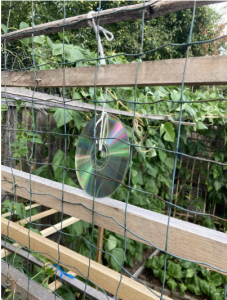
12. The Danny Woo Garden has so many layers. Not only is it terraced and built up with wooden structures surrounding the plots, but myriad fruit trees shade the garden and drop fruit into the plots and onto the pathways. In fact, Asian gardens – or at least Chinese gardens, to the extent of my knowledge from research – are characteristically diverse. Conventional gardens grown on a small plot of land the size of the Danny Woo Garden focus primarily on growing vegetables, whereas Chinese gardens act as mini farms (the distinction between “agriculture” and “gardening” blurred), growing vegetables, herbs, and fruit all in a compact area. Traditionally, “individual households were the basic unit of production,” so gardeners/families not only had to grow everything on their own land, but they could choose what they wanted to grow (Boileau 28). This allowed for a great diversity in what was grown in gardens, but the practice inevitably looks messier than a conventional Western garden. Seeing the garden’s layers helps us perceive a seemingly-nonexistent structure and order within the messiness.
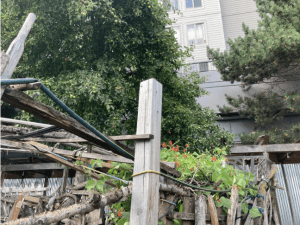
An image I took of the garden’s layers. In the foreground are trellises and garden structures supporting a flowering vine (I don’t know what type), and in the middle ground is an apple tree hanging over the garden.