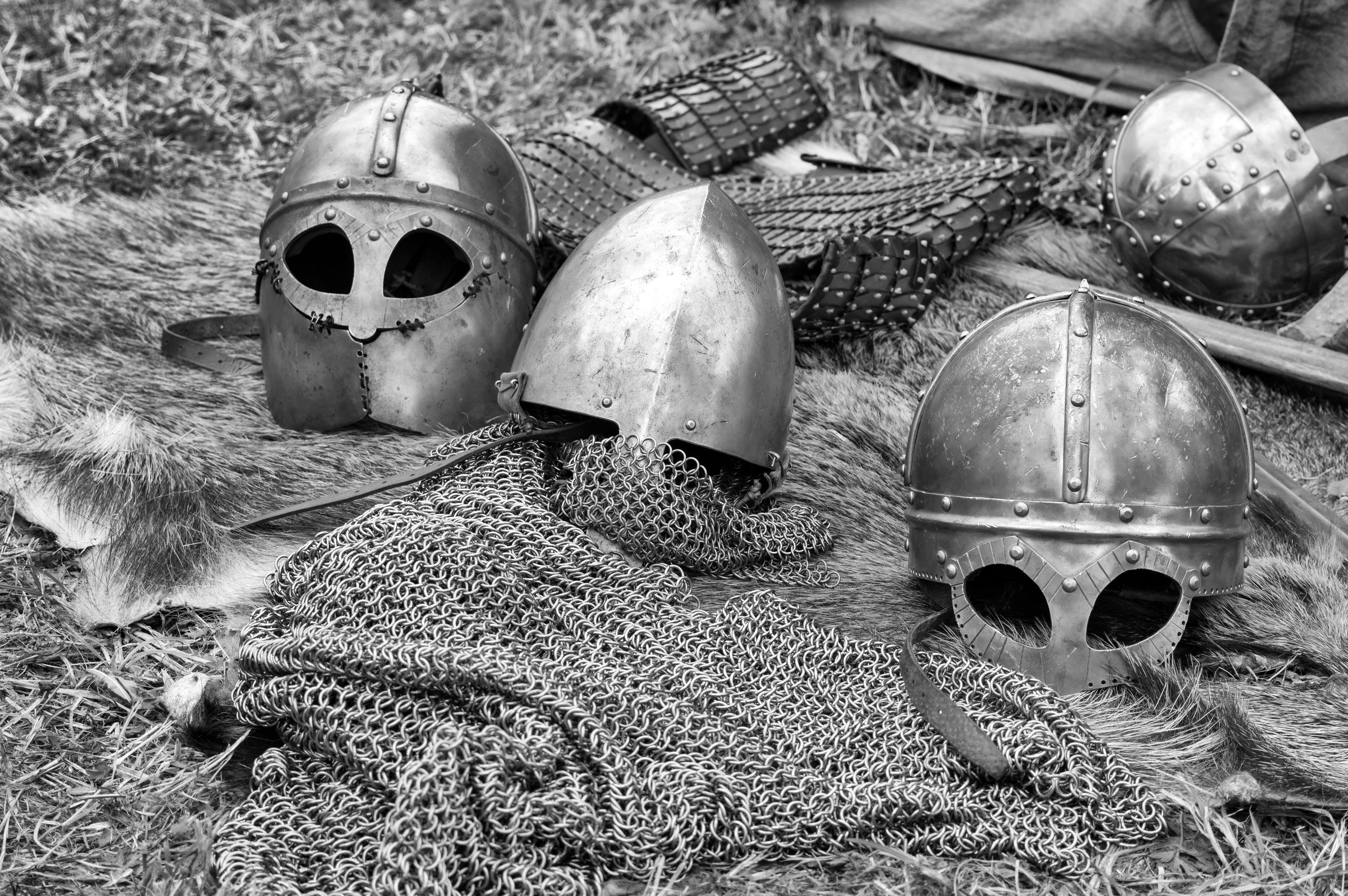
The depiction of the barbarian has dramatically changed over the course of centuries. The eighteenth and nineteenth centuries were characterized by multiple contexts that caused intellectuals studying Rome to create various arguments about the barbarian groups that existed in the first few centuries A.D. The rise of the age of imperialism shaped views on cultural transmission and aided in the development of Romanization as a concept. Intellectuals took distinct sides on the implications of Romanization, directly influencing modern views on barbarians. Some supported the view that Rome did not intentionally Romanize the barbarians, indicating that the barbarians were savages who invaded, sacked, and destroyed Rome. Others supported the opposite view, arguing that Rome got involved militarily in the frontier to Romanize barbarians, suggesting a more docile perspective on the barbarians of Late Antiquity. The rise of nationalism additionally contributed to the modern interpretation of the barbarian. Nationalist ideals encouraged nations to search for common heritages among the barbarians. The claim of barbarian tribes by groups of people painted a more passive and civilized view of those groups. However, a more aggressive depiction of the barbarian was created when other barbarian tribes were not claimed. The context of archaeology lends to certain depictions as well, providing new evidence of Roman commitment to permanently establishing both military bases and civilian settlements in the barbarian territories, contributing to the argument that Rome intentionally invaded the barbarians. The twentieth and twenty-first centuries added even more directly to how society understands the barbarians. Representations of barbarians in popular culture, whether it be movies, television shows, or video games, vastly determine common societal knowledge on who the barbarians of Late Antiquity were. However, when these contexts of imperialism, nationalism, archaeology, and popular culture that so heavily characterized the eighteenth, nineteenth, twentieth, and twenty-first centuries are removed, a much different picture of the barbarian emerges. This simultaneously new and more accurate depiction of the barbarian suggests that there was a greater complexity for which many barbarian groups are not given credit. This complex depiction extends to the religious practices, societal institutions, and self-identity of the barbarians.
The intricacy of barbarian identity is perhaps most immediately apparent in their diverse religious practices. Modern scholars and intellectuals have portrayed barbarians as pagans for centuries. While certainly some barbarian groups worshipped gods the Romans considered to be pagan, pagan is not a term that encompasses the totality of the religious practices of the barbarians. Multiple examples point to a complex amalgamation of religious beliefs among distinct groups of barbarians. For example. certain groups, such as the Goths and Visigoths, have been documented as Christians. In 402, the capital of the Western Roman Empire moved from Milan to Ravenna, which also happened to be the capital of the Gothic kingdom. As a result of this transition, “the construction of a religious geography in the city and of facilities to accommodate the court, such as an imperial palace, was naturally accompanied by masters and mosaicists who would have decorated interiors.” Due to Ravenna being under Gothic control, the works of these mosaicists provide insight into the religious beliefs of the Goths of the fifth century. One specific work lies in the Mausoleum of Galla Placidia, where a mosaic depicting a new interpretation of the Good Shepherd image is located. In this mosaic, a “figure wears a costly golden tunic and holds a golden cross instead of a wooden shepherd’s crook. He is shown seated – not standing, as in traditional images – turning towards one of the sheep while the rest of the flock surrounds him.” This specific depiction varies from other more traditional iconographies of the Good Shepherd image, which “implies the creation of a new meaning: the Good Shepherd of the Mausoleum of Galla Placidia is an image of the perpetual role of Christ as a shepherd, and makes reference to his sacrifice on the cross. But it also suggests his status as king, with the rock – earth itself – acting as his throne and the cross‑staff his sceptre. This is, indeed, a new interpretation of the Good Shepherd type, a considerably advanced expression of ideas using a common imagery.” The implementation of a modified iconography suggests a degree of analysis and intentionality by the Goths. Instead of simply copying older models of Christian imagery, the Goths created new iconographies to portray a specific notion: the supreme and unquestionable rule of Jesus. This concept is furthered through additional mosaics in the Mausoleum of Galla Placidia, such as the central dome. In this mosaic, “the cross, representing Christ, appears both on the starry sky and at the centre of the garland. Therefore, this image, although it differs from the one at the Rotunda, again conveys the meaning that Christ, represented by the cross in the starry dome, is the centre of the cosmos and, since the cross is situated at the centre of the garland, Christ exists eternally over the cycles of the seasons.” With Ravenna as the capital of the Gothic kingdom, the religious ideology exhibits the prominence of Christianity within Gothic culture. Similarly, the Visigoths displayed an equally strong commitment to Christianity, though the commitment manifested through their legal structures rather than art. Title I of Book I of the Liber Iudiciorum outlined the guidelines that Visigothic lawmakers should follow. Within the first few sections, the law code explicitly states that the lawmaker “should be mindful of his duty only to God and to himself.” Title I of Book II transitions from lawmaking to the enforcement of those laws by detailing the role of judges. The opening sections establish the source of true authority: “The Omnipotent Lord of all, sole Founder and Provider of the means of human salvation, ordered the inhabitants of the earth to learn justice from the sacred precepts of the law. And, because the mandate of Divinity has been thus imposed upon the human race, it is fitting that all terrestrial creatures, of however exalted rank, should acknowledge the authority of Him whom even the celestial soldiery obey.” This sentiment is echoed mere sentences later: “Willingly, therefore, carrying out the Divine commands, let us give temperate laws to ourselves and to our subjects; laws such as we and our successors, and the whole body of the people, may readily obey; so that no person of whatever rank or dignity may refuse to submit to the power of the law, which the necessity and will of the King has deemed it proper and salutary to inculcate.” It is clear that the Visigoths believed in God and revered His authority and power. The emphasis on Christianity in Visigothic culture is additionally evident through the high regard in which the clergy was held. Title I of Book II of the Liber Iudiciorum outlines the consequences for not obeying a request to appear in court, stating that “if any bishop, relying upon the privileges of the sacerdotal order, shall ignore the summons of the judge, and neglect to give security for his appearance, he shall, without delay, be compelled, either by the presiding judge, or by the governor or lord of the province, to pay a fine of fifty solidi: of which sum the judge shall receive twenty solidi, on account of contempt, and the plaintiff the remaining thirty.” While this may not appear significant on its own, when compared to the consequence for anyone else who refuses a court summons, the price for bishops is five times as much: “And if, after having received said summons, he should either delay, or refuse to appear, he shall forfeit five golden solidi to the plaintiff, on account of his delay or refusal, and five more to the judge on account of contempt.” Members of the clergy in Visigothic society were expected to be the epitome of a perfect citizen, and the increased price for failure to comply with such demands is a testament to that fact, once again highlighting the importance of Christianity within Visigothic society. While the Goths and Visigoths demonstrate the Christian dimension of barbarian religious identity, other groups like the Arabs illustrate how different faiths could become central to barbarian self-definition. The adoption of “Arab” as an ethnonym “replaced earlier identities and subsumed formerly disparate groups under a new umbrella – people changed who they thought they were and how they related to each other.” The reason for the adoption of this specific ethnonym is still widely debated. Some compare the adoption of “Arab” to “an ostensibly analogous case in Late Antiquity where a label for ‘other’ did transform into an ethnonym for ‘self’: this was the name ‘Berber’.” Others propose “that ‘Arabs’ derived their name from the land from whence they emerged.” However, both of these theories contain inherent problems that compromise the validity of such claims. Despite an unclear origin of the ethnonym “Arab”, there is strong evidence that points to the prevalence of religion in Arab identity. The Qur’an, which is the record of the revelations of the prophet Muhammed, is “the first Arabian record that makes multiple, unambiguous and self-reflexive references to the word arabī, citing it eleven times.” Additionally, “it calls itself ‘an Arabic Qur’an’ (qurān arabī) on six occasions, and refers to variants of ‘an Arabic language’ (lisān arabī) and ‘a clear Arabic’ (arabī mubīn) in the others.” The relationship between the Qur’an and Arab identity is a close one, and the “Qur’an constitutes only the beginning of a long process of ethnogenesis” for the Arabs. The religions of distinct barbarian groups were complex. Some remained pagan, perpetuating the notion that all barbarians were such; however, other groups, such as the Goths and Visigoths, became strong promoters of the Christian faith, which became reflected in various aspects including art and law. To add to the complexity, the Arab identity and Muslim faith became synonymous. Religion thus formed a crucial and diverse element of barbarian identity, contradicting simplistic pagan stereotypes; yet, religion is only one facet that exemplifies the complexities of barbarian identity.
The intricacy of barbarian identity extends beyond spiritual practices to the very structure of barbarian societies. This ambiguous nature of barbarian identity is evident through the political and military structures present in barbarian societies. In terms of political structures, barbarian groups differed by who held the power. Barbarian villages were “directed by the assembly of a headman whose position may have come from a combination of factors, including his wealth, family influence, and connections with the surpa-village leadership, that is, the people.” Barbarian kingdoms as a whole were governed by kings. Patrick Geary notes, “When the Romans first came into contact with the Celtic and Germanic peoples, these populations were largely governed by hereditary, sacral kings, who embodied the identity of their people.” The complexity in government began in the first and second centuries, where “those living in proximity to the Romans had largely abandoned their traditional sacral kings in favor of warrior leaders who might be selected from old royal families, or just as frequently, from the ranks of successful fighters.” Some barbarian groups held onto their kings, while other transitioned to warrior leaders, whose “legitimacy derived ultimately from their ability to lead their armies to victory.” The complexity of governmental power deepened in many of the barbarian societies that practiced Christianity, in which bishops held vast power. While kings would still be present, the bishops would hold political power, as well as religious power. The mosaics of Ravenna reflect this sentiment in the context of the Goths. For instance, “in the seventh century, the basilica of S. Apollinare in Classe received two new mosaic panels on either side of the apse. The one on the left is a narrative image of the emperor, Constantine IV (668–85), granting privileges to the bishop of Ravenna; the one on the right represents the sacrifice of Abel and Melchizedek in the presence of the Abraham and Isaac.” The right panel’s composition “gives greater emphasis to Melchizedek: his figure occupies the centre of the scene and is shown in hierarchical perspective, thus bigger in size than the others. His frontal position, with his hands on the table behind the chalice as if he was administering the liturgy, accentuates his prominence.” Overall, “the positions and gestures of the figures…express the prominence of the priest over Abel and Abraham.” The left panel depicts a different scene; however, the mosaic has undergone restorations, and “the changes resulting from these restorations generated scholarly debate about the historical event commemorated in the mosaic.” Despite the debate about the specific event, “the scene clearly reproduces the general iconography of the sixth‑century imperial panel with Justinian and Bishop Maximian in the church of San Vitale, while at the same time reinterpreting it through the insertion of new details.” Similarly to S. Vitale, the emperor wears the imperial purple cloak, and the churchmen dress in dark poenulae and white tunics. However, both of the first two churchmen wear garments typical of bishops: a dark poenula over a white tunic, and a white scarf around the neck. The second of these figures receives the codex from the emperor, and therefore he may be identified as Bishop Reparatus to whom the emperor granted the tax concessions.” The differences in this panel as opposed to the panel in the church of San Vitale present “Reparatus as a perfect successor in the city’s line of holy bishops.” Both panels establish the prominence of the priesthood in the Gothic kingdom, while simultaneously outlining the next in line for the position of bishop within Ravenna, the capital of the Gothic kingdom. Similar to the Goths, the Visigoths additionally established the vital role of the bishop in the government. Within the Visigothic kingdom, “the episcopacy occupied a central place in the formation and propagation of the kingdom’s decisions and the bishop had diverse responsibilities.” In addition to those diverse responsibilities, the bishop “was a central figure in late antique and early medieval Iberian life, with administrative, legal, municipal, and religious authority. The position of bishop is eminently portrayed in Visigothic law, and his role as judge – reinforcing the image of a fair bishop and responsible community leader – is evident.” One such law is evident in Book II Title I of the Liber Iudiciorum, which states that when the integrity of a judge was suspected, “those who decide the case shall do so with the bishop of the diocese.” The power of the bishop in barbarian political institutions was established thoroughly in communities that practiced Christianity.
Just as political organization varied significantly among barbarian groups, their military structures, namely weapons and tactics, revealed equally diverse and sophisticated approaches to warfare, contradicting notions of barbarian simplicity. In these contexts, it is important to note that much of the knowledge about barbarian weapon use and tactics originates from Roman sources. These Roman sources pose a slight issue when considering that Roman sources tended to exaggerate certain distinctions; however, the details provided still exemplify a complexity in both weapon use and tactics across barbarian groups. In terms of weapon use, many barbarian groups became distinguishable by their weapons. As a result, those weapons became synonymous with those various groups. For instance, weapons “such as Hunnic bows, Dacian javelins, Gothic lances, [and] Frankish axes appear in Roman sources.” According to these Roman sources, the Huns mainly sported bows, while Dacians wielded javelins, Goths brandished lances, and Franks used axes. Even if the Roman sources slightly exaggerated their respective uses, it is still evident that distinctions were evident between barbarian groups. Those distinctions extend to military tactics as well. Roman sources indicate that Scythic peoples, which included Goths, Huns, and Avars, fought primarily on horseback, as opposed to Germans and Celts, who fought primarily on foot. Once again, the exaggeration of Roman sources is somewhat present, especially when considering that western Germanic warriors were known to be mounted warriors “when their wealth and status allowed it”; however, the key is primarily. Germans were primarily foot soldiers, while other barbarian groups, such as the Goths, primarily fought on horseback, establishing another complexity across barbarian groups.
Beyond their religious practices and sociopolitical structure, perhaps the most fundamental intricacy of barbarian existence lay in how these people conceived of themselves. The label of “barbarian” was “an invented category, projected onto a variety of peoples.” In other words, Barbarian groups did not view themselves as barbarians. Rather, these individuals identified themselves with a variety of other institutions and labels that create an ambiguous identity. One of the major sources of identification in barbarian societies was with the nuclear family, which, unlike the clan, “was the primary unit of barbarian society.” These families were “integrated into the larger kindred known to scholars as the sip or clan.” Since most of the identification within barbarian societies was with the nuclear family, “membership within this larger circle was elastic.” Identification with the larger entity of the clan “provided the possibility but not the necessity of concerted action, since individuals might select from a variety of possible broader kin affiliations, depending on circumstances.” Clans were “bound together by a combination of religious, legal, and political traditions that imparted a strong, if unstable, sense of unity.” People who chose to identify together “shared common ancestry myths, cultural traditions, a legal system, and leaders. However, all of these were flexible, multiple, and subject to negotiation and even dispute.” The very nature of barbarian identity was complex, ambiguous, and multilayered. To add to this complexity, barbarian groups did not label themselves in the terms that others labeled them. References to barbarian weaponry distinguished various weapons by the people that brandished them, leading to “distinctive weapons…such as Hunnic bows, Dacian javelins, Gothic lances, or Frankish axes.” However, “even in the case of the Frankish ax, which seems, indeed, to have been a characteristic weapon by the end of the fifth century, the Franks themselves seem to have been less aware of it as a ‘Frankish’ tradition than were their enemies, the Visigoths and the Byzantines.” There is clear evidence that the people who were labeled “Franks” did not view themselves in such a way. Rather, various families drew upon “common ancestry myths, cultural traditions, a legal system, and leaders” to establish a group of people that others referred to as Franks. The introduction of heterogeneous confederations adds additional layers to the already complex self-identity of barbarians. While there are “no direct statements of how barbarians thought of themselves, we do have indirect indications that individuals could simultaneously hole several identities, seeing themselves as part of larger confederations as well as smaller groups.” One example of this can be found in the Alamannic confederation. The broader label of Alamanni refers to the groups that “settled into the Decumanian region, but maintained a loose and deeply divided sense of identity that only occasionally coalesced, usually under the desperate fear of their Roman neighbors.” The confederation that “fought the Emperor Julian in 357…was said to have been led by an uncle and nephew, called ‘the most outstanding in power before the other kings,’ five kings of second rank, ten regales, and a series of magnates.” The Alamanni were observed to be “composed of such groups such as the Bucinobantes, the Lentienses, and the Juthungi, under the leadership of their own kings.” These three barbarian groups identified both with their own families, as well as with other distinct families to become stronger in the face of the Romans. This notion is reinforced by the Franks, who “were composed of groups such as the Chamavi, the Chattuarii, the Bructeri, and the Amsivari.” An interesting aspect is introduced by the Franks in that they “could identify not only with these smaller units and with the broader Frankish confederation but with the Roman world as well.” The various ways in which barbarians could choose to identify indicate a greater degree of complexity with barbarian identity in Late Antiquity.
Barbarian identity is much more ambiguous than historians of the eighteenth and nineteenth centuries have led many to believe. Barbarian identity additionally deviates from the stereotypes that have resulted from popular culture depictions in the twentieth and twenty-first centuries. A good portion of barbarian groups were not the pagans many thought them to be. Some became devout Christians, while others centered an entire people around Islam. Additionally, some barbarian groups were politically centered around village headmen, while others centered around kings. Groups that practiced Christianity gave bishops a vast degree of political power in addition to their unquestioned religious authority. Military structures also serve as a point of ambiguity, where different groups fought with distinct weapons and different tactics. Perhaps the largest degree of complexity arises from the various ways in which a barbarian could self-identify, including with families, clans, confederations, or even with the Romans. Having dismantled the oversimplified barbarian stereotypes perpetuated by scholars and popular culture, the fundamental relationship between barbarian and Roman identities must be questioned: how much was barbarian identity truly tied to the Romans? Romans were responsible for introducing Christianity to certain groups, which served as a foundation for both religious and political ambiguities. Romans were additionally responsible for noting the distinctions in weapons and tactics that were variables across different groups. Romans were even to blame for the formation of certain barbarian confederations, which added an additional level of identification, that arose to create a stronger front against the Romans. Those do not even take into account the fact that some barbarians identified as Roman. Prevailing modern views suggest that Romans and barbarians were mutually exclusive identities; however, the opposite may be true. Barbarian may be just an extension of Roman identity, rather than simply an “other”. In more ways than one, Rome truly did create the barbarians.
1 Maria Cristina Carile, “Production, Promotion and Reception: The Visual Culture of Ravenna between Late Antiquity and the Middle Ages,” in Ravenna: Its Role in Earlier Medieval Change and Exchange, ed. Judith Herrin and Jinty Nelson (University of London Press, 2016), 54.
2 Carile, 54.
3 Carile, 55
4 Carile, 55, 58.
5 Carile, 62.
6 The Visigothic Code: (Forum judicum), ed. S. P. Scott (The Library of Iberian Resources Online), 2.
7 The Visigothic Code: (Forum judicum), 2.
8 The Visigothic Code: (Forum judicum), 2.
9 The Visigothic Code: (Forum judicum), 9.
10 The Visigothic Code: (Forum judicum), 8.
11 Peter Webb, Imagining the Arabs: Arab Identity and the Rise of Islam, (Edinburgh: Edinburgh University Press, 2016), 120.
12 Webb, 121.
13 Webb, 121.
14 Webb, 125.
15 Webb, 125.
16 Webb, 125.
17 Patrick Geary, The Myth of Nations: The Medieval Origins of Europe, (Princeton: Princeton University Press, 2003), 74.
18 Geary, 77.
19 Geary, 77.
20 Geary, 77.
21 Maria Cristina Carile, “Production, Promotion and Reception: The Visual Culture of Ravenna between Late Antiquity and the Middle Ages,” in Ravenna: Its Role in Earlier Medieval Change and Exchange, ed. Judith Herrin and Jinty Nelson (University of London Press, 2016), 70.
22 Carile, 70-71.
23 Carile, 71.
24 Carile, 72.
25 Carile, 72.
26 Carile, 72.
27 Carile, 74.
28 Flora Gusmão, “Role of the Bishop According to the Liber Iudiciorum (Lex Visigothorum),” in Symposium 1 (2016-2017) (2016-2017), para. 4.
29 Gusmão, para. 8.
30 The Visigothic Code: (Forum Judicum), ed. Scott (The Library of Iberian Resources Online), 11.
31 Patrick Geary, The Myth of Nations: The Medieval Origins of Europe, (Princeton: Princeton University Press, 2003), 75.
32 Patrick Geary, The Myth of Nations: The Medieval Origins of Europe, (Princeton: Princeton University Press, 2003), 76.
33 Geary, 63.
34 Geary, 74.
35 Geary, 73.
36 Geary, 74.
37 Geary, 74.
38 Geary, 74.
39 Geary, 74.
40 Geary, 75.
41 Geary, 75.
42 Geary, 74.
43 Geary, 84.
44 Geary, 84.
45 Geary, 84.
46 Geary, 84-85.
47 Geary, 85.
48 Geary, 85.